



Modernizing Server
Build Workflows for Scalable DevOps Operations
Modernizing Server Build Workflows for Scalable DevOps Operations Server
Build Automation is becoming essential for modern DevOps
Modernizing Server Build Workflows for Scalable DevOps Operations
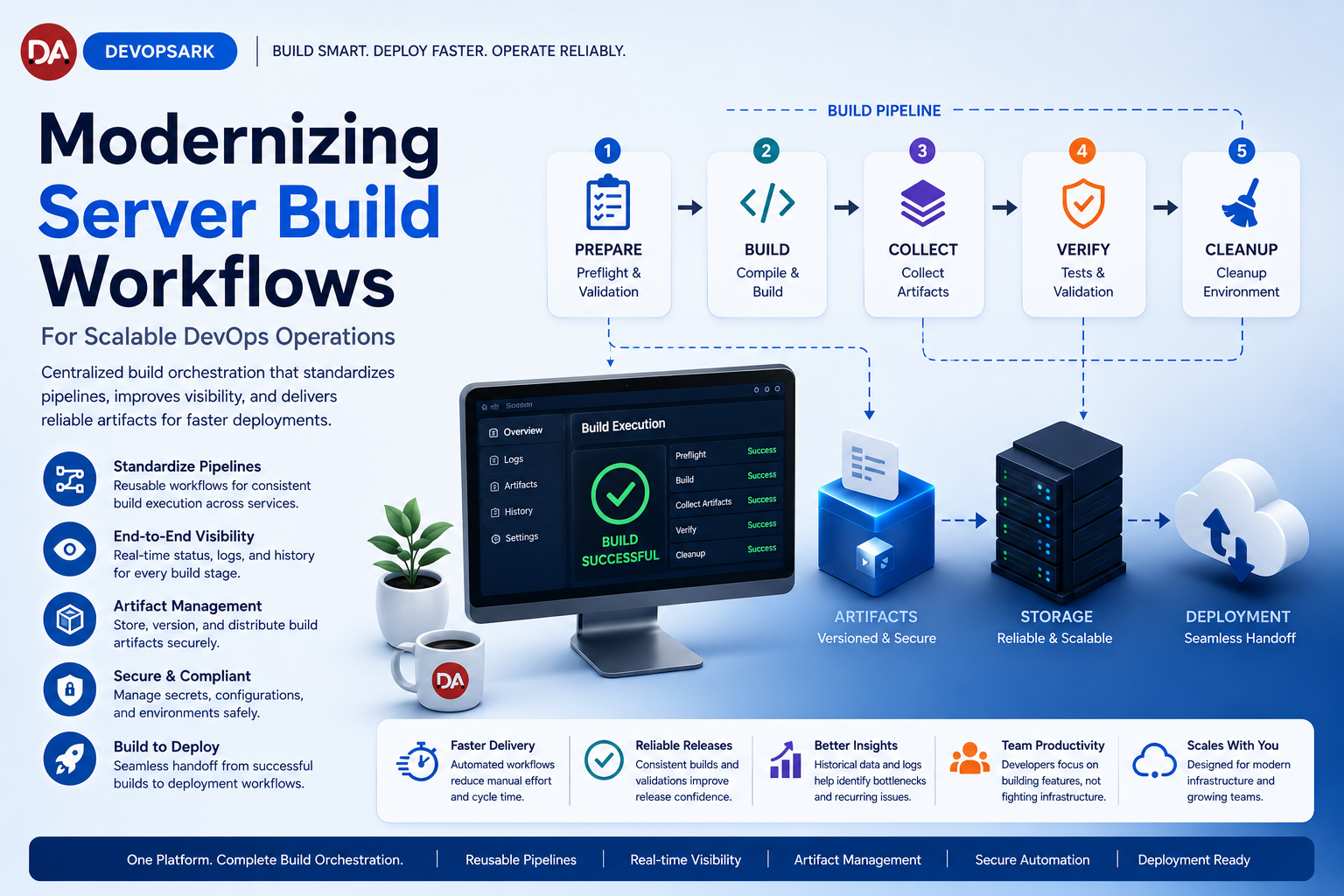
Server Build Automation is becoming essential for modern DevOps teams managing scalable application delivery, reusable build pipelines, artifact workflows, and deployment-ready infrastructure operations. Modern software delivery depends heavily on reliable build operations. Every application release, infrastructure update, deployment package, and production rollout begins with a successful build workflow. As organizations scale cloud-native applications, Kubernetes infrastructure, distributed engineering teams, and continuous delivery practices, build operations themselves become significantly more important to overall DevOps reliability.
However, many organizations still manage server build workflows through fragmented scripts, isolated CI jobs, manually maintained environments, and disconnected operational tooling.
What initially works for a small engineering team often becomes difficult to maintain as infrastructure complexity increases.
Build failures become harder to troubleshoot. Artifact handling becomes inconsistent. Environment drift introduces operational unpredictability. Build-to-deployment coordination slows down release cycles. Teams spend more time managing automation than improving delivery efficiency.
Modern DevOps environments require far more than isolated build scripts.
They require centralized, observable, and reusable build orchestration.
As engineering organizations scale, server build workflows are evolving from simple automation tasks into critical operational systems that directly impact release reliability, deployment speed, and engineering productivity.
Why Build Operations Matter More Than Ever
Modern applications operate across increasingly complex infrastructure environments.
Organizations now manage:
- Kubernetes workloads
- Cloud-native applications
- Hybrid infrastructure
- Multi-environment deployments
- Continuous delivery pipelines
- Distributed microservices
- Runtime configuration systems
- Security validation workflows
- Artifact distribution pipelines
Every deployment depends on reliable build execution.
A modern server build workflow often includes:
- Source synchronization
- Environment preparation
- Dependency management
- Pre-build validation
- Multi-stage build execution
- Artifact generation
- Security validation
- Runtime verification
- Cleanup operations
- Deployment handoff preparation
Each stage introduces operational dependencies that must execute consistently across environments.
As release frequency increases, even small inconsistencies inside build workflows can create large operational bottlenecks.
This is why build orchestration has become one of the most important operational layers inside modern DevOps environments.
The Challenges of Traditional Build Management
Many engineering teams still rely heavily on manually coordinated build systems.
Scripts are maintained separately across repositories. Build environments behave differently between teams. Artifact handling is inconsistent. Logs are spread across multiple systems. Troubleshooting requires manually tracing execution behavior through fragmented operational workflows.
Over time, this creates several common operational challenges.
Inconsistent Build Execution
Different repositories and teams often follow different build patterns. This introduces operational inconsistency across environments and increases the likelihood of release failures.
Limited Execution Visibility
Many build systems provide minimal insight into execution phases, runtime behavior, environment issues, or artifact generation processes.
When failures occur, engineering teams spend valuable time diagnosing where execution actually failed.
Artifact Management Complexity
Modern applications generate multiple artifacts across build workflows. Without centralized management, artifact traceability becomes difficult to maintain reliably.
Environment Drift
Build environments often evolve independently across teams and infrastructure systems, leading to inconsistent runtime behavior and deployment unpredictability.
Manual Build-to-Deployment Coordination
Many organizations still manage build and deployment operations separately, creating delays, version mismatches, and operational handoff inefficiencies.
As infrastructure complexity grows, these challenges become significantly harder to manage manually.
Understanding Modern Server Build Orchestration
Modern build orchestration is no longer limited to simply compiling code.
It has evolved into a centralized operational framework responsible for coordinating build execution, environment management, artifact handling, troubleshooting visibility, release preparation, and deployment readiness across infrastructure environments.
A modern server build platform should help organizations:
- Standardize build workflows
- Improve operational consistency
- Centralize execution visibility
- Simplify troubleshooting
- Manage artifacts efficiently
- Coordinate deployment handoffs
- Improve release reliability
- Support scalable automation workflows
This operational model helps organizations move from fragmented build automation toward structured delivery orchestration.
Why Reusable Build Workflows Improve Reliability
One of the biggest shifts in modern DevOps operations is the move toward reusable build orchestration.
Traditionally, engineering teams create repository-specific scripts and independently managed workflows. While flexible initially, this approach becomes difficult to scale operationally.
Reusable build workflows improve consistency by enabling organizations to standardize:
- Build stages
- Runtime environments
- Artifact handling
- Environment configuration
- Validation workflows
- Security integration
- Operational visibility
Instead of maintaining disconnected automation logic across multiple teams, organizations create repeatable build patterns that improve operational maturity and reduce delivery risk.
This becomes especially valuable for organizations managing large numbers of services and deployment environments.
Multi-Stage Build Automation in Modern DevOps
Modern server build workflows typically involve multiple coordinated execution stages.
A structured build workflow may include:
- Preflight validation
- Repository synchronization
- Dependency preparation
- Build execution
- Artifact collection
- Verification processes
- Cleanup operations
Each stage contributes to overall build reliability.
If one phase behaves inconsistently, downstream release and deployment workflows may also become unstable.
This is why modern build orchestration platforms emphasize structured execution visibility and stage-based operational monitoring.
Engineering teams require clear insight into:
- Execution progress
- Runtime status
- Failure conditions
- Artifact generation
- Environment behavior
- Build history
- Operational dependencies
This level of visibility dramatically improves troubleshooting speed and operational confidence.
Artifact Management Is a Critical Part of Modern Delivery
Artifacts are now central to modern software delivery pipelines.
Applications, release packages, binaries, deployment bundles, and runtime assets all depend on reliable artifact generation and distribution.
However, many organizations still struggle with fragmented artifact workflows.
Common operational problems include:
- Missing build outputs
- Inconsistent artifact naming
- Poor traceability between builds and releases
- Manual artifact transfers
- Difficulty validating release packages
- Limited download visibility
Modern build orchestration platforms improve artifact reliability by integrating artifact generation, storage visibility, verification, and deployment coordination into centralized workflows.
This significantly improves release consistency while reducing operational overhead.
Build Visibility and Operational Troubleshooting
As engineering environments scale, execution visibility becomes increasingly important.
Build failures are inevitable in distributed infrastructure environments.
The operational difference lies in how quickly teams can identify and resolve issues.
Without centralized visibility, troubleshooting often becomes fragmented across:
- Repository logs
- CI systems
- Runtime environments
- Build scripts
- Infrastructure consoles
- Terminal sessions
Modern server build orchestration improves troubleshooting through:
- Real-time execution monitoring
- Stage-by-stage visibility
- Structured runtime timelines
- Historical execution tracking
- Centralized logs
- Artifact-aware troubleshooting
This operational clarity reduces downtime, accelerates engineering response time, and improves overall delivery efficiency.
Integrating Build and Deployment Workflows
One of the biggest inefficiencies in traditional DevOps operations is the disconnect between build systems and deployment workflows.
Build artifacts are often transferred manually between systems, introducing delays and operational inconsistencies.
Modern DevOps environments increasingly require integrated build-to-deployment orchestration.
Successful build outputs should transition smoothly into deployment workflows while maintaining:
- Artifact traceability
- Runtime consistency
- Release visibility
- Execution continuity
- Operational governance
As release frequency increases, seamless build-to-deployment coordination becomes essential for maintaining delivery reliability at scale.
Secure Environment and Configuration Management
Modern build workflows frequently require environment-specific variables, runtime configurations, repository credentials, and secure operational access.
Managing these manually creates significant security and operational risks.
Hardcoded credentials, inconsistent configuration handling, and unmanaged environment drift can introduce vulnerabilities and deployment instability across infrastructure systems.
Modern build orchestration platforms therefore prioritize:
- Centralized environment management
- Secure secret handling
- Runtime configuration consistency
- Environment portability
- Reusable configuration workflows
This improves both operational reliability and infrastructure security.
Event-Driven Build Automation and External Integrations
Modern DevOps environments increasingly rely on event-driven automation.
Repositories, CI systems, release workflows, and external automation platforms often need to trigger builds automatically based on operational events.
Webhook-driven orchestration improves delivery responsiveness by enabling:
- Automated build execution
- External workflow integration
- Faster CI/CD coordination
- Reduced manual intervention
- Consistent trigger workflows
- Scalable automation integration
As automation maturity increases, event-driven build orchestration becomes a core component of modern software delivery operations.
Why Centralized Build Orchestration Matters
As infrastructure complexity continues growing, centralized build visibility becomes significantly more important than isolated automation.
Centralized server build orchestration helps organizations:
- Improve execution consistency
- Accelerate troubleshooting
- Improve release reliability
- Simplify artifact management
- Reduce operational drift
- Standardize delivery workflows
- Improve deployment coordination
- Scale DevOps operations more effectively
Instead of relying on fragmented scripts and disconnected operational processes, engineering teams gain unified visibility across build workflows, runtime environments, artifacts, and release pipelines.
This operational clarity becomes essential for scaling modern DevOps infrastructure successfully.
The Future of Server Build Automation
Server build automation continues evolving alongside cloud-native infrastructure and modern platform engineering practices.
Modern DevOps environments increasingly require:
- Reusable build orchestration
- Real-time execution visibility
- Multi-stage workflow management
- Artifact-aware delivery systems
- Build-to-deployment coordination
- Event-driven automation
- Secure configuration management
- Integrated DevSecOps validation
- Centralized operational visibility
The future of build automation is not simply about building applications faster.
It is about creating reliable, observable, scalable, and operationally manageable delivery workflows across increasingly complex infrastructure environments.
Organizations that modernize build orchestration while improving operational visibility and consistency will scale software delivery far more effectively.
Final Thoughts
Modern DevOps environments depend heavily on reliable server build orchestration across repositories, infrastructure systems, runtime environments, deployment workflows, and cloud-native platforms.
As infrastructure complexity increases, traditional build management approaches often become fragmented, inconsistent, and operationally difficult to scale.
The modern challenge in DevOps is no longer simply running builds.
It is maintaining centralized, observable, and reusable build workflows that support scalable software delivery operations across rapidly evolving infrastructure environments.
Organizations that prioritize operational consistency, artifact reliability, execution visibility, and integrated delivery workflows will be better positioned to accelerate innovation without increasing operational complexity.
Recent Posts
- The Hidden Cost of Too Many Dashboards: Why Infrastructure Visibility Gets Harder as Systems Grow
- Why Kubernetes Starts Feeling Unpredictable After a Certain Scale
- Server Deployment Automation: Why Reliable Deployments Become Difficult at Scale
- Modernizing Server Build Workflows for Scalable DevOps Operations
- CI/CD Pipeline Chaos: Why Modern DevOps Teams Need Better Workflow Automation