



Security Scanning
Chaos: Why DevOps Teams Struggle with Visibility at Scale
Security Scanning Chaos: Why DevOps Teams Struggle with Visibility
at Scale Security Scanning in DevSecOps
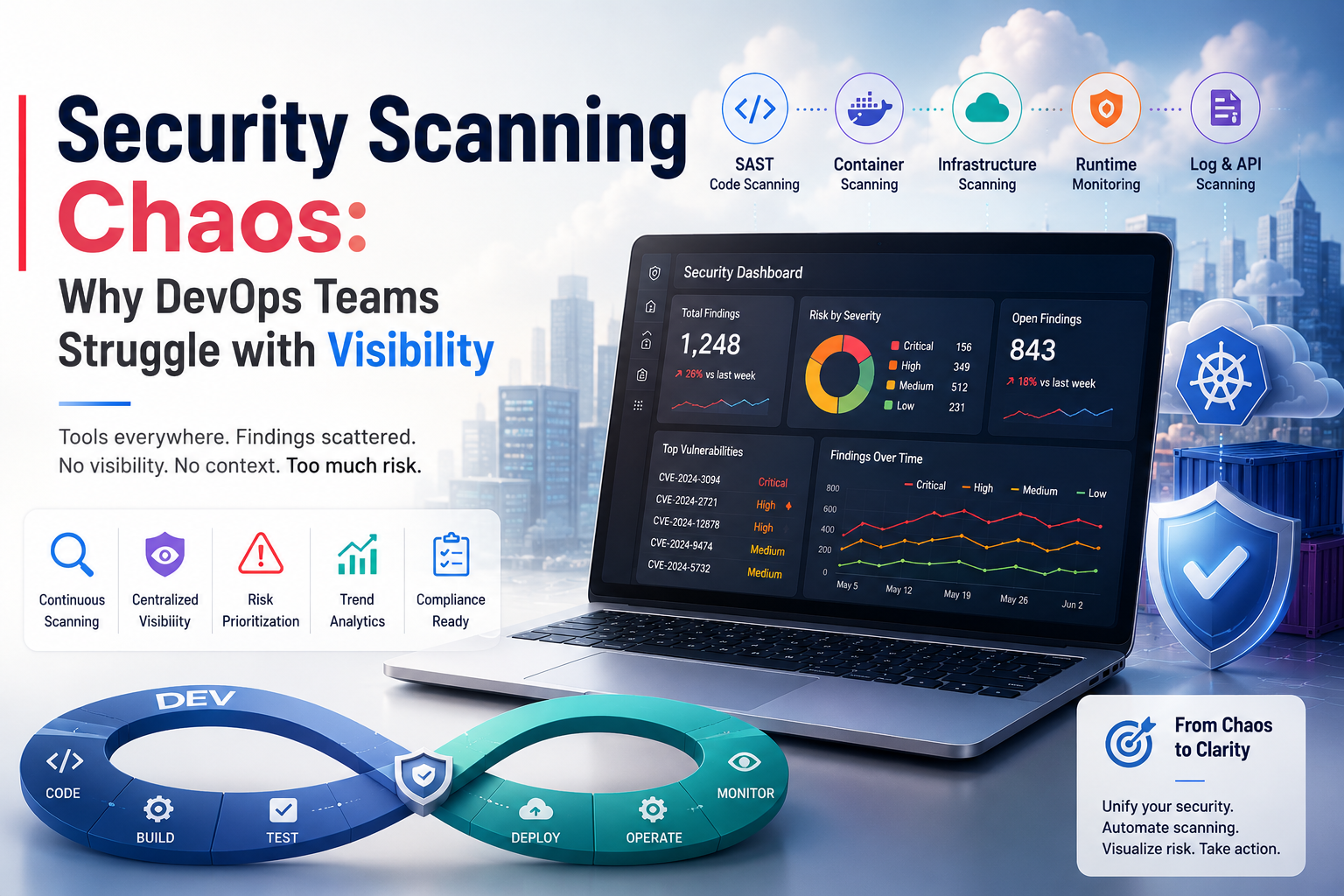
Security Scanning Chaos: Why DevOps Teams Struggle with Visibility at Scale
Security Scanning in DevSecOps has become one of the most important requirements for modern cloud-native infrastructure. As organizations scale Kubernetes environments, containers, APIs, CI/CD pipelines, and multi-cloud infrastructure, maintaining continuous visibility into vulnerabilities, runtime threats, and operational security risks becomes increasingly difficult.
Modern DevSecOps teams operate across highly distributed environments where infrastructure changes continuously. Applications are deployed multiple times every day, workloads scale dynamically, and security findings are generated across multiple platforms simultaneously.
While organizations continue adopting more security tools, many teams still struggle with fragmented visibility, disconnected workflows, duplicated alerts, and operational security complexity at scale.
Over the last few years, software delivery has evolved dramatically. Applications are no longer released once every few months through rigid deployment cycles. Engineering teams now deploy continuously across hybrid infrastructure, Kubernetes clusters, cloud platforms, and microservices architectures. Development velocity has increased significantly, but security operations have become much harder to manage effectively.
Most organizations already use multiple security scanning tools across different stages of the software delivery lifecycle. Teams implement source code security scanners, container vulnerability scanning platforms, cloud security monitoring systems, runtime threat detection tools, compliance validators, API security scanners, and infrastructure security solutions.
Initially, each tool solves a specific problem.
Over time, however, organizations begin facing a much larger challenge — fragmented security visibility.
Security findings become scattered across dashboards, CI/CD logs, cloud consoles, spreadsheets, vulnerability reports, ticketing systems, emails, and monitoring platforms. Different engineering teams follow different remediation workflows. Security alerts are duplicated across tools. Historical visibility becomes difficult to maintain. Compliance reporting turns into a manual process.
Eventually, organizations realize the problem is no longer simply running security scans.
The real challenge is maintaining continuous security visibility at scale.
The Growing Complexity of Modern DevSecOps
Modern infrastructure environments are fundamentally different from traditional application environments.
Applications no longer run on a few centralized virtual machines inside static data centers. Today’s cloud-native environments span:
- Kubernetes clusters
- Multi-cloud infrastructure
- Containerized applications
- APIs and microservices
- Distributed runtime systems
- CI/CD automation pipelines
- Hybrid cloud deployments
- Dynamic infrastructure environments
Infrastructure evolves constantly. Containers scale automatically. New services are deployed daily. Cloud resources appear and disappear dynamically based on demand.
This operational flexibility enables faster software delivery, but it also introduces significant security complexity.
Every deployment introduces multiple layers of security exposure:
- Source code vulnerabilities
- Dependency risks
- Container image weaknesses
- Infrastructure misconfigurations
- Identity and access issues
- Runtime threats
- API security risks
- Compliance violations
- Network exposure problems
As organizations scale DevSecOps operations, maintaining visibility across these layers becomes extremely difficult without centralized security management.
Why Traditional Security Scanning No Longer Works
Traditional security approaches were designed for slower release cycles and predictable infrastructure.
Security reviews often happened after development was complete. Vulnerability assessments were periodic rather than continuous. Compliance audits were performed manually every few months.
That model no longer works in modern DevSecOps environments.
Today, engineering teams deploy multiple times per day. Kubernetes workloads scale continuously. Infrastructure changes through automation. APIs evolve rapidly. Cloud resources are provisioned dynamically.
A vulnerability identified weeks after deployment may already exist across production environments, customer-facing systems, APIs, and distributed workloads.
Modern DevSecOps requires continuous security monitoring instead of isolated security events.
Without continuous visibility, organizations lose awareness of emerging risks across rapidly evolving infrastructure environments.
This is why modern security scanning platforms are shifting toward centralized visibility and continuous operational monitoring.
Understanding Modern Security Scanning in DevSecOps
Modern security scanning extends far beyond traditional vulnerability detection. It now involves continuous analysis across development pipelines, infrastructure environments, runtime systems, cloud workloads, and operational activity.
Different layers of infrastructure require different types of security visibility.
Source Code Security Scanning
Source code security scanning helps identify vulnerabilities during development before applications reach production environments.
Modern source code analysis focuses on detecting:
- Hardcoded credentials
- Injection vulnerabilities
- Unsafe coding patterns
- Dependency vulnerabilities
- Authentication weaknesses
- Authorization issues
- Configuration risks
Integrating security scanning directly into development workflows allows teams to identify vulnerabilities earlier, reduce remediation costs, and improve release confidence.
As DevSecOps practices mature, source code security scanning becomes an essential part of secure software delivery pipelines.
Container Security Scanning for Kubernetes and Cloud-Native Applications
Containerized applications now power modern cloud-native infrastructure. However, containers also introduce additional attack surfaces that organizations must continuously monitor.
Container vulnerability scanning helps organizations identify:
- Vulnerable packages
- Insecure base images
- Dependency exposure
- Exposed secrets
- Misconfigured containers
- Compliance violations
- Runtime security risks
Without continuous container security scanning, vulnerable workloads can spread rapidly across Kubernetes clusters and production environments.
As Kubernetes adoption continues growing, container security visibility has become one of the most important operational requirements in modern DevSecOps environments.
Organizations running cloud-native applications require centralized visibility into container security posture across development, staging, and production infrastructure.
Cloud Infrastructure Security and Continuous Compliance Monitoring
Modern infrastructure environments evolve continuously through automation.
Cloud resources scale dynamically. Kubernetes nodes change frequently. Infrastructure configurations update through deployment pipelines and infrastructure-as-code workflows.
This operational agility creates major security challenges.
Infrastructure security scanning helps organizations detect:
- Publicly exposed resources
- Weak access controls
- Excessive permissions
- Unencrypted storage
- Risky network configurations
- Compliance violations
- Infrastructure drift
Misconfigured infrastructure remains one of the leading causes of modern cloud security incidents.
Continuous cloud infrastructure security monitoring helps organizations maintain visibility into evolving infrastructure risks while improving governance across cloud-native environments.
Runtime Security Monitoring and Threat Detection
Static security scanning alone is no longer sufficient for modern distributed systems.
Applications must also be monitored continuously while running inside production environments.
Runtime security monitoring enables organizations to identify:
- Suspicious process activity
- Authentication anomalies
- Unauthorized access attempts
- Runtime vulnerabilities
- Abnormal network behavior
- Infrastructure drift
- Threat indicators across workloads
As distributed systems become increasingly dynamic, runtime threat detection becomes essential for maintaining operational security visibility.
Continuous runtime monitoring allows security teams to respond faster to threats before incidents escalate across production systems.
Log Security Analysis and Operational Visibility
Logs contain critical operational and security intelligence across infrastructure environments.
Every API request, authentication event, deployment action, infrastructure change, and runtime interaction generates valuable security data.
However, modern environments produce enormous amounts of operational logs every day.
Without centralized visibility, important threat indicators become buried inside operational noise.
Security-focused log analysis helps organizations identify:
- Brute force attacks
- Suspicious authentication behavior
- Privilege escalation attempts
- Unauthorized API access
- Compliance-related events
- Abnormal operational patterns
In modern DevSecOps environments, logs are no longer simply operational records.
They are a critical part of continuous security visibility.
The Real Problem: Fragmented Security Visibility
Most organizations already have security scanning tools.
The real challenge is fragmented operational visibility.
Security teams often struggle to answer critical questions quickly:
- Which workloads are currently vulnerable?
- Which vulnerabilities remain unresolved?
- Which deployments introduced new risks?
- Which infrastructure components fail compliance policies?
- Which Kubernetes workloads are exposed publicly?
- Which teams own remediation responsibilities?
- Which vulnerabilities are growing over time?
When security findings remain distributed across disconnected systems, DevSecOps operations become reactive instead of proactive.
Teams spend more time searching for information than improving security posture.
This fragmentation creates operational inefficiencies across engineering, compliance, and security workflows.
Why Centralized Security Visibility Matters
As infrastructure complexity grows, centralized security visibility becomes significantly more important than simply deploying additional security tools.
A centralized security scanning platform enables organizations to:
- Consolidate security findings
- Standardize remediation workflows
- Improve operational awareness
- Reduce alert fatigue
- Track vulnerability trends
- Simplify compliance reporting
- Accelerate vulnerability remediation
- Improve security governance
Instead of managing disconnected dashboards and isolated security workflows, teams gain unified visibility across code, containers, Kubernetes infrastructure, APIs, runtime systems, and cloud environments.
This operational clarity helps organizations scale security operations more effectively.
The Impact of Alert Fatigue in DevSecOps
One of the biggest operational challenges in modern security operations is alert fatigue.
As organizations deploy more security scanning tools, the volume of generated findings increases dramatically. Developers and security teams become overwhelmed by duplicate alerts, disconnected notifications, low-priority findings, and inconsistent reporting systems.
Eventually, critical alerts lose urgency because teams become desensitized to excessive alert volume.
This creates dangerous operational blind spots.
Effective DevSecOps security operations are not about generating the highest number of alerts.
They are about delivering actionable visibility with meaningful prioritization.
Organizations require security scanning platforms capable of reducing operational noise while improving visibility into critical risks.
Continuous Security Monitoring Is Becoming Essential
Modern DevSecOps environments require continuous security monitoring across the entire software delivery lifecycle.
Instead of treating security as a separate phase, organizations now integrate security visibility directly into infrastructure operations and development workflows.
Continuous security monitoring enables organizations to:
- Detect vulnerabilities earlier
- Reduce production exposure
- Improve deployment confidence
- Strengthen compliance visibility
- Accelerate remediation cycles
- Improve operational governance
- Maintain centralized security posture awareness
This operational model allows organizations to scale infrastructure securely without slowing down development velocity.
Why Security Visibility Is Now a Business Requirement
Security visibility is no longer just a technical requirement for engineering teams.
It directly impacts:
- Business continuity
- Customer trust
- Compliance readiness
- Incident response capability
- Infrastructure reliability
- Release confidence
- Operational stability
Organizations operating modern Kubernetes, cloud-native, and multi-cloud environments cannot effectively manage operational risk without centralized security visibility.
As infrastructure complexity continues increasing, scalable security operations become a critical business requirement.
The Future of Security Scanning and DevSecOps
The future of DevSecOps security will not be defined by how many tools organizations deploy.
It will be defined by how effectively organizations unify operational visibility across modern infrastructure environments.
Modern security operations are evolving toward:
- Continuous security monitoring
- Centralized security management
- Infrastructure-wide visibility
- Runtime threat detection
- Automated remediation workflows
- Intelligent vulnerability prioritization
- Kubernetes security visibility
- Cross-environment risk analysis
- Cloud-native security operations
Organizations that simplify security operations while improving visibility will scale faster, operate more securely, and respond more effectively to emerging threats.
Final Thoughts
Modern DevSecOps environments generate massive amounts of security data across repositories, containers, Kubernetes workloads, cloud infrastructure, APIs, runtime systems, and operational logs.
Without centralized visibility, security operations quickly become fragmented, reactive, and difficult to manage at scale.
The modern challenge in DevSecOps is no longer simply running security scans.
The real challenge is maintaining continuous visibility across rapidly evolving infrastructure environments.
Organizations that prioritize centralized security management, continuous monitoring, vulnerability visibility, and operational simplicity will be better positioned to secure modern cloud-native infrastructure without slowing down innovation.
Frequently Asked Questions
What is security scanning in DevSecOps?
Security scanning in DevSecOps refers to the continuous process of identifying vulnerabilities, misconfigurations, compliance issues, and security risks across source code, containers, infrastructure, APIs, runtime environments, and cloud platforms throughout the software delivery lifecycle.
Why is continuous security monitoring important?
Continuous security monitoring helps organizations detect vulnerabilities and operational risks earlier across rapidly evolving infrastructure environments. It improves visibility, accelerates remediation, strengthens compliance posture, and reduces production security exposure.
What is container security scanning?
Container security scanning is the process of analyzing container images and workloads for vulnerabilities, insecure dependencies, exposed secrets, misconfigurations, and compliance risks before and after deployment.
Why is Kubernetes security visibility important?
Kubernetes environments are highly dynamic and distributed. Continuous Kubernetes security visibility helps organizations monitor workloads, configurations, runtime behavior, infrastructure exposure, and operational risks across cloud-native environments.
What are the biggest challenges in modern DevSecOps security?
Modern DevSecOps teams commonly struggle with fragmented security tooling, disconnected vulnerability visibility, alert fatigue, inconsistent remediation workflows, compliance reporting complexity, and maintaining continuous visibility across distributed infrastructure environments.
Recent Posts
- The Hidden Cost of Too Many Dashboards: Why Infrastructure Visibility Gets Harder as Systems Grow
- Why Kubernetes Starts Feeling Unpredictable After a Certain Scale
- Server Deployment Automation: Why Reliable Deployments Become Difficult at Scale
- Modernizing Server Build Workflows for Scalable DevOps Operations
- CI/CD Pipeline Chaos: Why Modern DevOps Teams Need Better Workflow Automation