



DMK8S: Simplifying
Kubernetes Management Across Cloud, Hybrid, and On-Prem Infrastructure
DMK8S: Kubernetes Management Platform for Multi-Cloud Infrastructure Kubernetes management
platforms are becoming essential for organizations running cloud-native
DMK8S: Kubernetes Management Platform for Multi-Cloud Infrastructure
Kubernetes management platforms are becoming essential for organizations running cloud-native infrastructure at scale. As Kubernetes adoption grows across enterprises, managing clusters across cloud, hybrid, and on-premises environments becomes increasingly complex.
Kubernetes has fundamentally changed the way modern applications are built, deployed, and scaled. What started as a container orchestration platform has now become the backbone of cloud-native infrastructure for startups, enterprises, SaaS platforms, fintech systems, AI workloads, and large-scale distributed applications.
Today, organizations rely on Kubernetes to run mission-critical workloads because of its scalability, portability, resilience, and automation capabilities.
But despite its advantages, Kubernetes operations remain extremely complex.
For many engineering teams, the challenge is no longer “Should we use Kubernetes?” but rather “How do we manage Kubernetes efficiently at scale?”
Installing clusters, configuring networking, upgrading Kubernetes versions, maintaining security policies, managing multi-cloud environments, monitoring infrastructure health, handling node scaling, and ensuring operational consistency across environments often require deep expertise and significant engineering effort.
As infrastructure grows, Kubernetes management itself becomes a full-time operational responsibility.
This is where DMK8S (Deploy & Manage Kubernetes) from DevOpsArk is designed to make a difference.
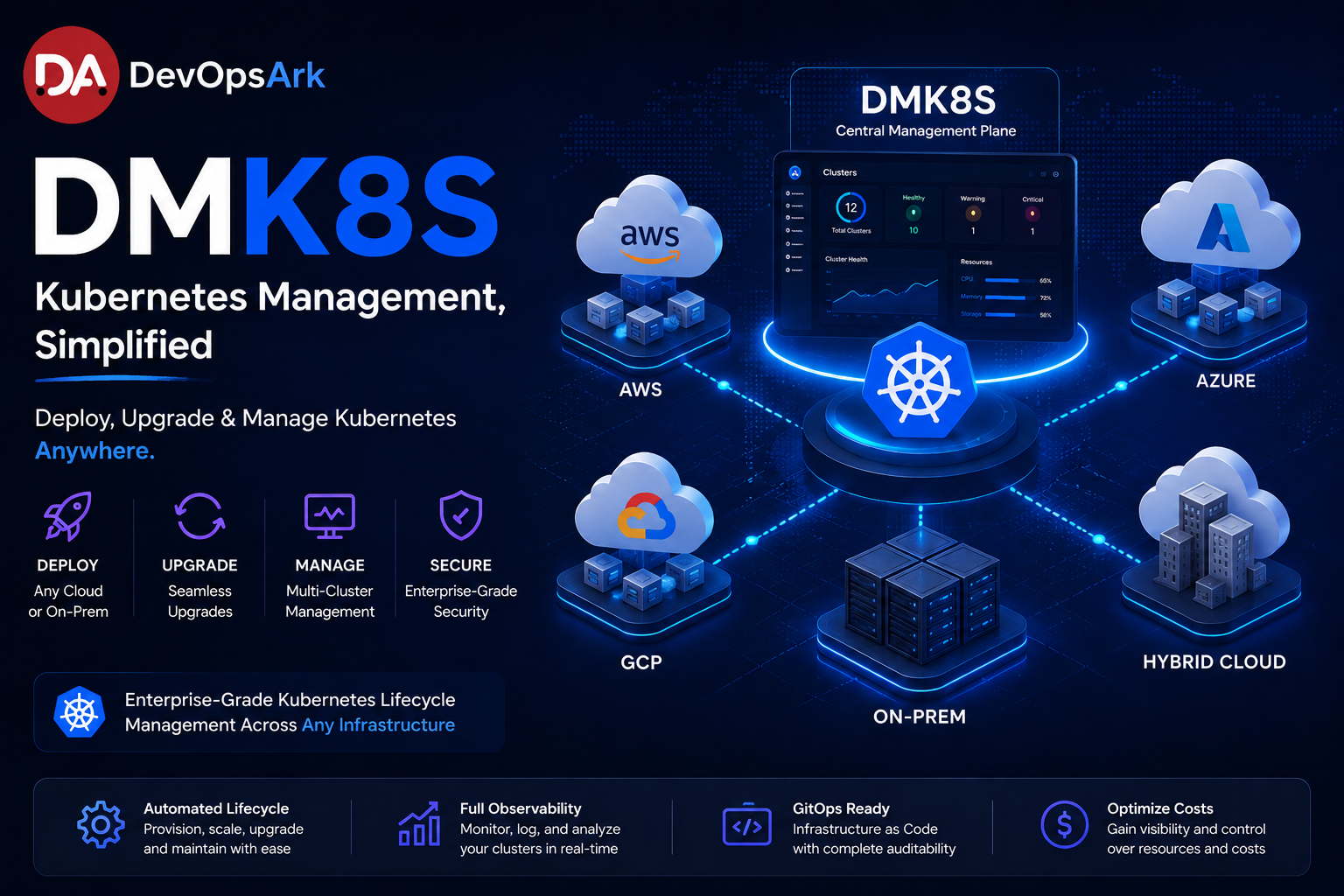
DMK8S is an enterprise Kubernetes lifecycle management platform built to simplify how organizations deploy, operate, upgrade, and manage Kubernetes clusters across any infrastructure environment.
The Growing Complexity of Kubernetes Operations
Kubernetes offers incredible flexibility, but that flexibility often comes with operational overhead.
A single production Kubernetes cluster involves far more than simply installing Kubernetes components.
Teams must think about infrastructure provisioning, networking, ingress management, storage configuration, observability, RBAC policies, cluster upgrades, disaster recovery, compliance requirements, and workload scaling.
As organizations adopt microservices architectures and multi-environment deployments, Kubernetes infrastructure quickly expands into multiple clusters spread across different regions and cloud providers.
A typical enterprise environment may include:
- Development clusters
- Staging clusters
- Production clusters
- Regional clusters
- Isolated customer environments
- Temporary CI/CD clusters
- Disaster recovery clusters
Managing all of these environments independently becomes operationally exhausting.
Many teams attempt to solve this using scripts, infrastructure-as-code templates, cloud-native tools, and multiple dashboards.
But over time, operational inconsistency begins to appear. Each environment behaves differently. Upgrade processes become risky. Security configurations drift. Visibility decreases. Operational complexity grows.
This is one of the biggest reasons platform engineering has become such a critical discipline in modern infrastructure teams.
Organizations are increasingly looking for standardized ways to operate Kubernetes infrastructure without sacrificing flexibility or control.
DMK8S addresses exactly this challenge.
What is DMK8S?
DMK8S is DevOpsArk’s Kubernetes lifecycle management solution built for organizations that want to simplify Kubernetes operations across cloud, hybrid, and on-premises environments.
At its core, DMK8S is designed to automate the most operationally difficult parts of Kubernetes management.
Instead of relying on fragmented tooling and manual operational workflows, DMK8S provides a centralized Kubernetes Management Platform where teams can provision, upgrade, scale, monitor, and manage Kubernetes clusters consistently.
The platform supports Kubernetes lifecycle operations including:
- Cluster provisioning
- Infrastructure configuration
- Kubernetes upgrades
- Multi-cluster management
- Observability integration
- Security policy enforcement
- Automation workflows
- Infrastructure standardization
One of the most important aspects of DMK8S is that it remains infrastructure agnostic.
Organizations are not locked into a single cloud provider or deployment model.
Teams can deploy Kubernetes clusters on:
- Amazon Web Services (AWS)
- Microsoft Azure
- Google Cloud Platform (GCP)
- VMware environments
- OpenStack infrastructure
- Bare metal datacenters
- Hybrid cloud architectures
This gives organizations the flexibility to design infrastructure strategies that align with business, compliance, performance, or cost requirements without introducing operational fragmentation.
Benefits of Using a Kubernetes Management Platform
Modern infrastructure environments require operational consistency, scalability, security, and automation.
A Kubernetes Management Platform helps organizations standardize Kubernetes operations while reducing manual infrastructure complexity.
DMK8S provides a centralized Kubernetes Management Platform for deploying, upgrading, monitoring, and managing Kubernetes clusters across cloud, hybrid, and on-premises infrastructure.
| Feature | DMK8S | Traditional Kubernetes |
|---|---|---|
| Multi-Cloud Support | ✅ | ⚠️ Complex |
| Automated Upgrades | ✅ | ❌ Manual |
| Centralized Management | ✅ | ❌ Multiple Tools |
| Observability | ✅ | ⚠️ Separate Tools |
| Security Governance | ✅ | ⚠️ Manual Setup |
Simplifying Kubernetes Deployment
Installing Kubernetes manually is rarely simple, especially in production environments.
A production-ready cluster requires much more than running a few installation commands.
Teams must configure networking plugins, initialize control plane nodes, provision worker nodes, configure ingress controllers, establish storage layers, integrate observability tooling, and implement access control policies.
Each infrastructure environment introduces its own challenges.
AWS networking behaves differently from Azure networking. Bare metal environments require completely different operational considerations compared to cloud infrastructure.
Hybrid deployments introduce even more complexity around connectivity, security, and routing.
DMK8S simplifies this process through automated cluster provisioning workflows.
- Kubernetes version
- Node sizing
- Networking configuration
- High availability architecture
- Storage preferences
- Scaling policies
- Security standards
Once configured, DMK8S automates the deployment process and provisions production-ready Kubernetes environments consistently across infrastructure providers.
This drastically reduces the time and expertise required to operationalize Kubernetes clusters.
Final Thoughts
Kubernetes has become essential for modern cloud-native infrastructure, but managing Kubernetes efficiently at scale remains a major operational challenge for many organizations.
DMK8S from DevOpsArk is designed to simplify Kubernetes lifecycle management through automation, centralized operations, multi-cloud support, enterprise security, and infrastructure standardization.
Rather than forcing teams to manage fragmented tooling and operational workflows manually, DMK8S provides a unified operational platform for deploying and managing Kubernetes infrastructure predictably and efficiently.
- CI/CD
- Cloud Infrastructure
- Cloud Native
- Container Orchestration
- DevOps
- DevOps Automation
- DevOpsArk
- DMK8S
- Enterprise Kubernetes
- GitOps
- Hybrid Cloud
- Infrastructure Automation
- Kubernetes
- Kubernetes Automation
- Kubernetes Cluster Management
- Kubernetes Lifecycle Management
- Kubernetes Management
- Kubernetes Management Platform
- Multi-Cloud Kubernetes
- Observability
- Platform Engineering
Recent Posts
- The Hidden Cost of Too Many Dashboards: Why Infrastructure Visibility Gets Harder as Systems Grow
- Why Kubernetes Starts Feeling Unpredictable After a Certain Scale
- Server Deployment Automation: Why Reliable Deployments Become Difficult at Scale
- Modernizing Server Build Workflows for Scalable DevOps Operations
- CI/CD Pipeline Chaos: Why Modern DevOps Teams Need Better Workflow Automation