



DevOps Cost
Visibility: The Hidden Drain on Your Cloud Budget
Introduction: When Speed Outpaces Awareness Over the last decade,
DevOps has redefined how modern systems are built
Introduction: When Speed Outpaces Awareness
Over the last decade, DevOps has redefined how modern systems are built and delivered. What once took weeks—provisioning infrastructure, configuring environments, deploying applications—now happens in minutes. Teams have embraced automation, scalability, and continuous delivery as the foundation of their workflows.
But while engineering velocity has increased dramatically, financial awareness hasn’t kept pace.
Infrastructure today is no longer static. It scales dynamically, adapts to traffic, and evolves with every deployment. This flexibility is powerful—but it comes with a hidden trade-off. As systems become more distributed and automated, the cost behind them becomes harder to interpret.
Organizations often find themselves in a situation where everything appears operationally efficient—systems are stable, deployments are smooth, performance is optimized—but the cloud bill tells a different story.
And the real challenge isn’t the size of the bill.
It’s the lack of clarity behind it.
The Nature of Modern Infrastructure: Distributed and Dynamic
To understand why cost visibility is such a challenge, it’s important to look at how modern infrastructure actually behaves.
Applications today are not confined to a single server or environment. They are composed of multiple services, often deployed across different cloud providers, running in containers, orchestrated dynamically, and scaled based on real-time demand.
Each of these components contributes to cost:
- Compute resources scale up and down
- Storage grows with usage
- Network traffic fluctuates continuously
These costs are not generated in isolation. They are interconnected, influenced by deployments, traffic patterns, and architectural decisions.
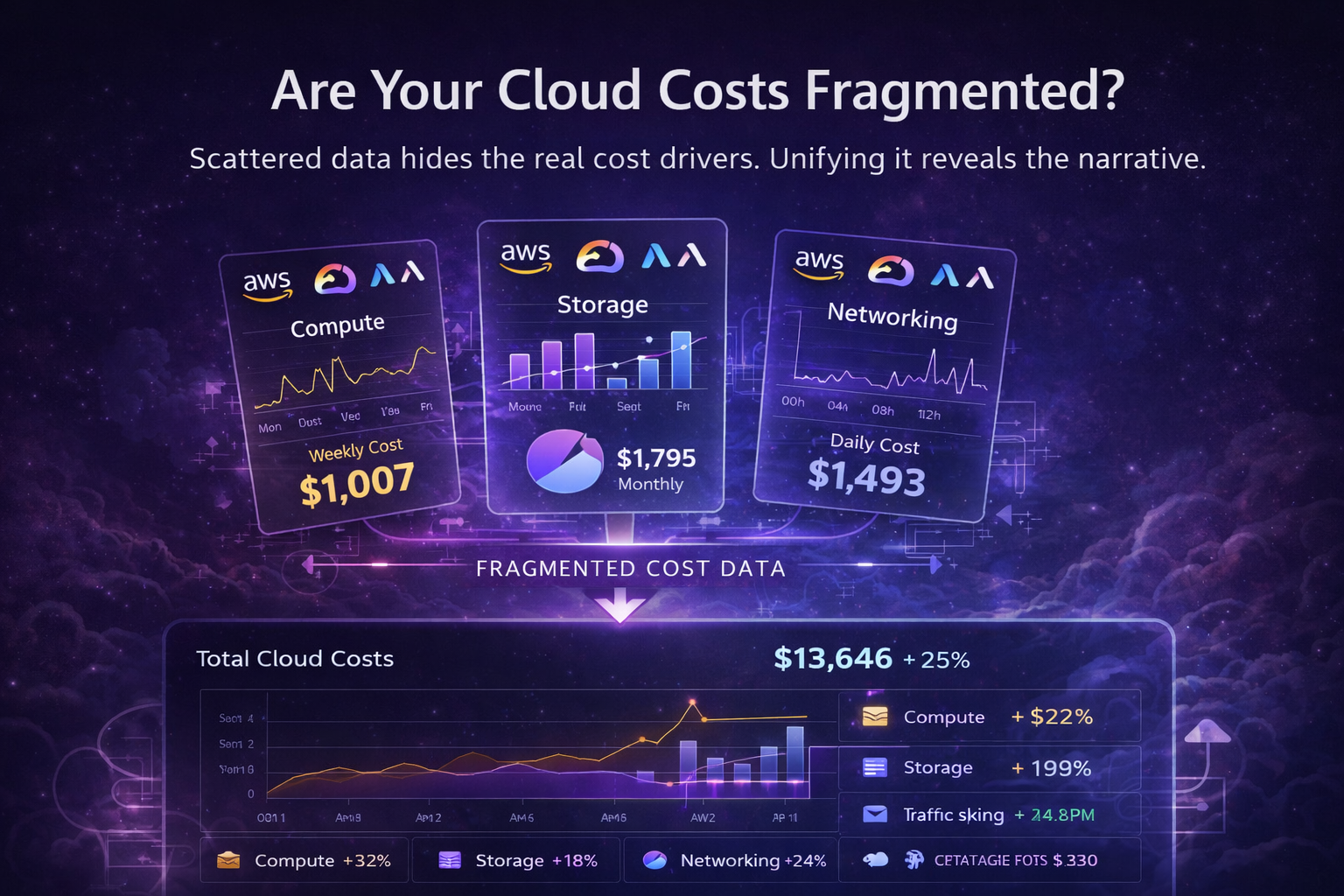
But while systems are designed to be interconnected, cost data is not.
Instead, it remains fragmented—distributed across providers, dashboards, and timeframes—making it difficult to build a complete picture.
The Illusion of Visibility
Most teams believe they have visibility into their costs because they have access to billing dashboards. But access does not equal understanding.
Traditional billing views are often:
- Provider-specific
- Aggregated at a high level
- Structured for accounting, not engineering
They answer questions like:
- “What is our total spend this month?”
But they don’t answer:
- “How did this evolve over time?”
- “What changed in our system that influenced this?”
- “Is this behavior expected or unusual?”
This creates an illusion of visibility—where data is available, but insight is missing.
And without insight, cost becomes something teams react to, rather than manage.
Cost as a Reflection of System Behavior
One of the most overlooked aspects of infrastructure cost is that it is not just a financial metric—it is a reflection of system behavior.
Every cost change has a cause:
- A deployment that increased resource usage
- A traffic spike that triggered scaling
- A configuration that altered system efficiency
When viewed in isolation, cost appears as a number.
When viewed in context, it becomes a signal.
A signal that tells you:
- How your system is evolving
- How efficiently resources are being used
- Where potential inefficiencies may exist
But to interpret this signal, cost data needs to be structured in a way that aligns with how systems operate—not just how billing works.
From Fragmentation to Perspective
The key challenge, then, is not collecting cost data—it’s organizing it.
When cost information is brought together into a unified perspective, something important happens. It stops being a collection of numbers and starts becoming a narrative.
A narrative that answers:
- How spending is changing over time
- Where patterns are forming
- When deviations occur
This shift—from fragmented data to structured perspective—is what enables teams to move from reactive analysis to proactive awareness.
Instead of asking, “Why was the bill high?” at the end of the month, teams begin to ask,
“What is happening to our cost right now?”
The Importance of Time in Cost Analysis
Cost is inherently time-dependent. It evolves continuously, influenced by both predictable and unexpected factors.
Looking at cost as a static number hides this behavior.
Looking at it over time reveals it.
When cost is observed across timeframes:
- Short-term views reveal immediate changes
- Medium-term views show trends
- Long-term views highlight growth patterns
This layered understanding allows teams to:
- Detect gradual increases that might otherwise go unnoticed
- Identify patterns linked to deployments or usage cycles
- Understand whether a change is temporary or systemic
In this context, cost becomes less about “how much” and more about “how it behaves.”
Awareness Before Optimization
There is a common misconception that cost optimization starts with reducing resources. In reality, it starts much earlier—with awareness.
Without understanding:
- What is changing
- When it is changing
- How it is changing
Any attempt to optimize becomes guesswork.
Teams may reduce resources in one area while inefficiencies continue elsewhere. They may react to visible spikes while ignoring slow, consistent growth.
True optimization requires clarity.
And clarity begins with visibility.
Integrating Cost Into Engineering Thinking
For cost visibility to be effective, it cannot exist in isolation from engineering workflows. It needs to become part of how teams think about systems.
Just as engineers monitor:
- Performance metrics
- Error rates
- System health
They should also be able to observe:
- Cost behavior
- Spending patterns
- Financial impact of changes
This doesn’t mean turning engineers into finance experts.
It means giving them the context needed to understand the consequences of their decisions.
When cost becomes part of the engineering conversation, decision-making improves naturally—without forcing it.
From Awareness to Control
Once visibility is established, control follows.
Not because systems change automatically, but because teams are better equipped to act.
They can:
- Investigate changes with confidence
- Align infrastructure decisions with financial impact
- Avoid surprises by recognizing patterns early
Control, in this sense, is not about restricting usage—it’s about enabling informed action.
And informed action is what ultimately leads to efficiency.
Conclusion: The Cost of Not Knowing
In modern DevOps environments, complexity is unavoidable. Systems will continue to scale, architectures will evolve, and infrastructure will become even more dynamic.
But one thing should not remain complex:
Understanding where your money is going.
Because the real cost problem is not overspending.
It is unseen spending.
The kind that grows quietly.
The kind that goes unnoticed.
The kind that only becomes visible when it’s too late.