



Multi Cloud
Management: Why It Is More Complex Than You Think
Multi cloud management has become a common
strategy for modern organizations. Instead of depending on
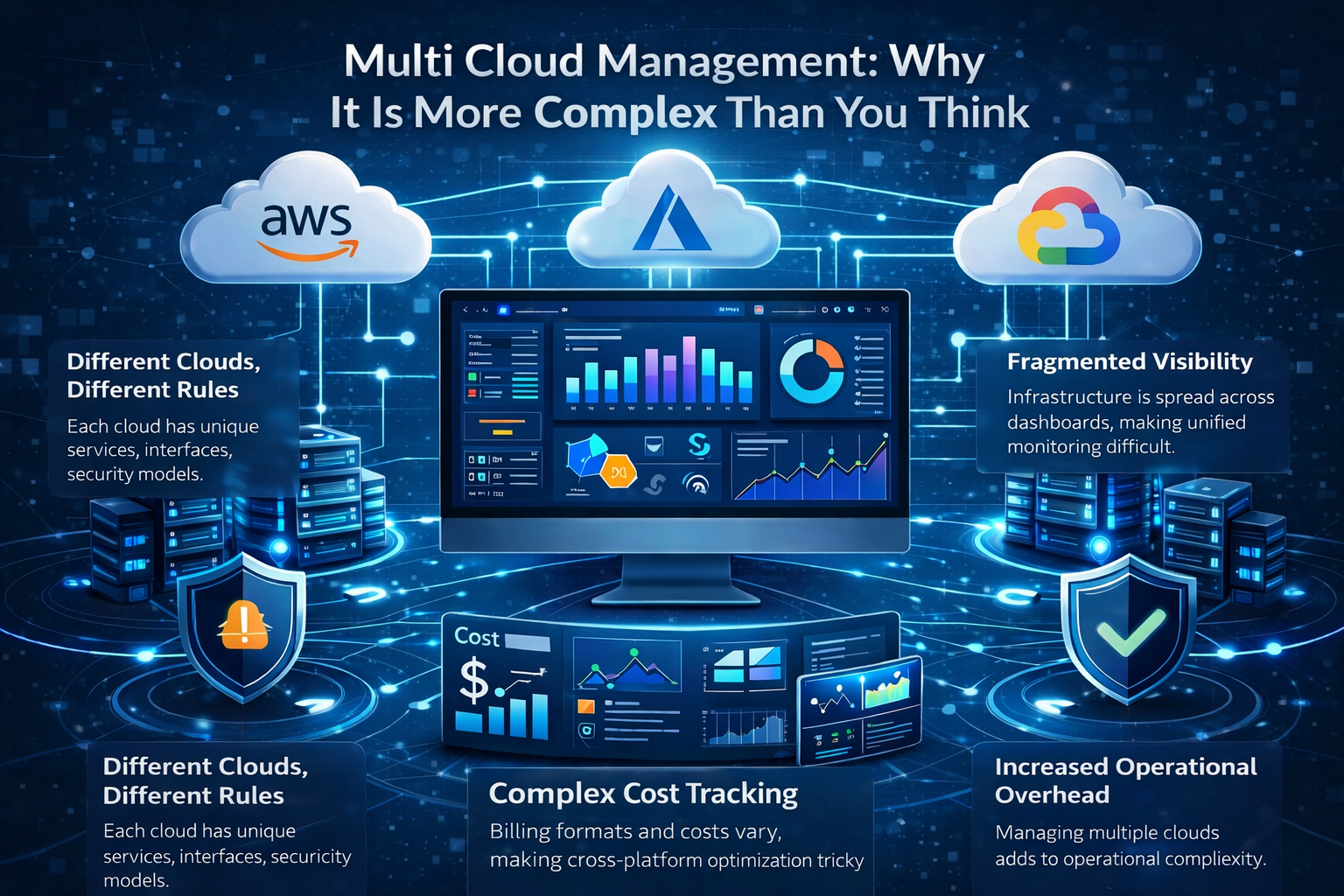
Multi cloud management has become a common strategy for modern organizations. Instead of depending on a single provider, businesses now distribute workloads across platforms such as AWS, Azure, and Google Cloud to improve resilience, avoid vendor lock-in, and gain access to specialized services.
On paper, this sounds like the ideal approach. More flexibility, better pricing options, and stronger reliability. However, once organizations begin operating across multiple cloud environments, they often discover that the real challenge is not adopting multiple clouds — it is managing them efficiently.
The complexity of operating across different providers introduces new problems in visibility, governance, cost control, security, and day-to-day operations. What appears to be a strategic advantage can quickly become an operational burden if not handled correctly.
Different Clouds, Different Rules
Every cloud provider offers its own ecosystem of services, networking models, identity systems, and management interfaces. Even when two providers offer similar services, the way they are configured and managed can be completely different.
A virtual machine in one provider may use a different networking model than another. IAM roles, firewall rules, storage policies, and monitoring tools all vary between platforms. This means teams must learn multiple systems instead of mastering one consistent operational model.
As environments grow, this difference in tooling and terminology increases the learning curve and slows down operations.
The Visibility Problem
One of the first challenges teams face in multi cloud management is lack of visibility. Infrastructure is spread across providers, each with separate dashboards, metrics, and reporting systems.
Without a unified view, it becomes difficult to answer simple operational questions:
- Which workloads are consuming the most resources?
- Where are costs increasing?
- Which environments are underutilized?
- Are all systems healthy right now?
When information is fragmented, decision-making becomes slower and less accurate.
Cost Management Becomes Harder
Many organizations adopt multiple cloud providers to optimize pricing. In reality, costs often become harder to track.
Each provider has its own billing format, pricing structure, discounts, and usage reports. Comparing spend across platforms is rarely straightforward. Hidden charges such as data transfer, storage operations, and reserved capacity can create unexpected expenses.
Without centralized cost visibility, teams may save money in one area while overspending in another.
Security and Governance Challenges
Security becomes more difficult when policies must be enforced across different platforms. Identity models, permissions, logging standards, and compliance controls vary from one provider to another.
This creates several risks:
- Inconsistent access policies
- Misconfigured resources
- Gaps in audit visibility
- Difficulty proving compliance
Managing governance manually across multiple providers is time-consuming and error-prone.
Operational Overhead Increases
Running a single cloud environment already requires strong operational discipline. Running multiple clouds increases that effort significantly.
Teams must maintain separate expertise, handle provider-specific incidents, monitor different APIs, and respond to issues using multiple tools. Even routine tasks such as provisioning resources or troubleshooting connectivity become more complex.
Instead of reducing dependency, organizations may end up increasing operational overhead.
Why Strategy Alone Is Not Enough
Many companies approach multi cloud management as a business decision, but success depends equally on operational execution.
Using multiple providers without a management strategy often leads to:
- Fragmented operations
- Rising costs
- Reduced visibility
- Slower incident response
- Increased security risk
The value of multi-cloud comes only when complexity is controlled.
The Need for Unified Management
To make multi cloud management successful, organizations need a unified operating model. Teams require centralized visibility, consistent governance, and streamlined operations across all providers.
This includes:
- Unified infrastructure visibility
- Cross-cloud cost tracking
- Consistent security controls
- Standardized workflows
- Faster incident response
With the right approach, multiple clouds can become an advantage instead of a burden.
Where Modern Platforms Help
Platforms like DevOpsArk help simplify multi cloud management by providing a centralized layer for managing infrastructure, operations, and governance across providers.
Instead of switching between disconnected dashboards and tools, teams can work from a more unified environment with better visibility and control.
Conclusion
Multi cloud management offers flexibility and resilience, but it also introduces significant operational complexity. The challenge is not choosing multiple providers — it is managing them consistently at scale.
Organizations that focus on visibility, governance, and unified operations are better positioned to unlock the true value of a multi-cloud strategy without being overwhelmed by its complexity.
Recent Posts
- The Hidden Cost of Too Many Dashboards: Why Infrastructure Visibility Gets Harder as Systems Grow
- Why Kubernetes Starts Feeling Unpredictable After a Certain Scale
- Server Deployment Automation: Why Reliable Deployments Become Difficult at Scale
- Modernizing Server Build Workflows for Scalable DevOps Operations
- CI/CD Pipeline Chaos: Why Modern DevOps Teams Need Better Workflow Automation