



Reducing DevOps
Cognitive Load with DevOpsArk Platform
DevOps cognitive load has become a critical challenge as
modern infrastructure grows increasingly complex. Why DevOps Cognitive
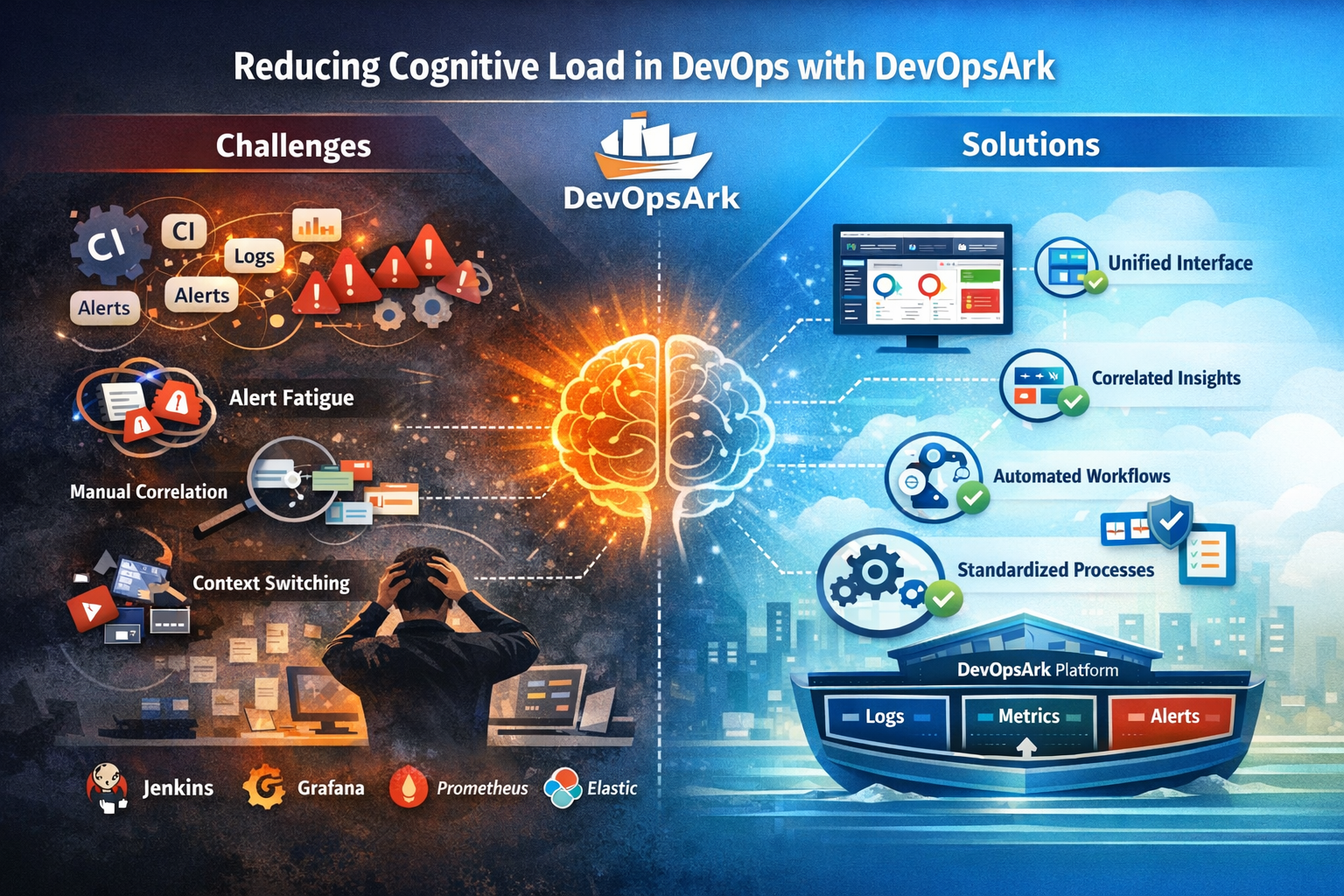
DevOps cognitive load has become a critical challenge as modern infrastructure grows increasingly complex.
Why DevOps Cognitive Load Is Increasing in Modern Systems
The evolution of DevOps over the past decade has fundamentally transformed how software is built, deployed, and operated. Organizations have embraced automation, continuous integration and delivery pipelines, containerization, and distributed system architectures to achieve higher velocity and scalability. Technologies such as Kubernetes for orchestration, Prometheus for metrics collection, and Grafana for visualization have become standard components of modern infrastructure stacks.
However, while these advancements have improved system capabilities, they have simultaneously introduced a new class of challenges that are not purely technical but cognitive in nature. As systems become more distributed and toolchains more extensive, the mental effort required to operate, debug, and maintain these environments increases significantly.This phenomenon, commonly referred to as DevOps cognitive load, is emerging as one of the primary constraints on DevOps efficiency and scalability.
In this context, the role of unified DevOps platforms such as DevOpsArk becomes increasingly important, as they aim to address not just infrastructure complexity but also the human limitations associated with managing that complexity.
The Nature of Cognitive Load in DevOps Environments
Cognitive load, in the context of DevOps, can be defined as the total mental effort required by engineers to understand system behavior, interpret operational data, and execute workflows effectively. Unlike infrastructure costs or latency metrics, cognitive load is not directly measurable through traditional monitoring systems, yet it has a profound impact on productivity, reliability, and team performance.
Modern DevOps environments require engineers to simultaneously interact with multiple layers of abstraction, including infrastructure, orchestration platforms, application services, networking components, and security systems. Each layer introduces its own set of tools, interfaces, and data representations. For example, an engineer investigating a production issue may need to analyze metrics in Prometheus, visualize trends in Grafana, inspect logs in a search engine, and trace service dependencies across distributed components.
The challenge is not the availability of data, but the fragmentation of that data across multiple systems, each requiring separate mental models. Engineers must continuously translate information between these systems, leading to increased cognitive effort and a higher likelihood of errors.
Toolchain Fragmentation and Its Impact
One of the most significant contributors to cognitive overload in DevOps is the fragmented nature of toolchains. Over time, organizations adopt specialized tools for different functions—CI/CD pipelines, logging systems, monitoring platforms, alerting mechanisms, and security scanners. While each tool is optimized for its specific purpose, there is often minimal integration at the level of user experience.
This fragmentation introduces several systemic inefficiencies. First, it increases the number of interfaces engineers must interact with, each with its own conventions and workflows. Second, it prevents seamless correlation of data, requiring manual effort to connect events across systems. Third, it creates inconsistencies in how information is presented, forcing engineers to maintain multiple mental models simultaneously.
For instance, an alert generated by a monitoring system may not directly link to the relevant logs or deployment events that caused the issue. As a result, engineers must manually navigate between systems, reconstruct timelines, and infer relationships. This process is not only time-consuming but also cognitively demanding.
Cognitive Load During Incident Response
The effects of cognitive load become particularly evident during incident response scenarios, where time sensitivity and system complexity intersect. In an ideal environment, incident response should be guided by clear, actionable insights that enable engineers to quickly identify root causes and implement fixes.
In practice, however, incident response often involves navigating a maze of alerts, dashboards, and logs. Engineers must determine which alerts are relevant, identify affected services, and correlate data across multiple sources. This process introduces significant decision overhead, as engineers must constantly evaluate where to focus their attention.
The absence of contextual information further exacerbates the problem. Alerts are often generated based on threshold breaches without sufficient context about their impact or relationship to other events. Consequently, engineers may spend valuable time investigating symptoms rather than root causes.
This inefficiency directly impacts Mean Time to Recovery (MTTR) and increases the risk of prolonged outages.
Alert Fatigue and Information Overload
Another critical aspect of cognitive load in DevOps is alert fatigue, which arises when engineers are exposed to a high volume of alerts with varying levels of importance. In many systems, alerting mechanisms are configured conservatively to ensure that no potential issue goes unnoticed. However, this often results in an overwhelming number of notifications, many of which are redundant or non-actionable.
Over time, engineers become desensitized to alerts, leading to slower response times and the possibility of critical issues being overlooked. The root cause of this problem is not the presence of alerts themselves, but the lack of intelligent filtering, prioritization, and correlation.
Effective alerting systems should provide not just notifications, but context—information about the affected components, potential causes, and recommended actions. Without this context, alerts contribute to cognitive overload rather than reducing it.
The Limitations of Tool-Centric Approaches
The traditional approach to addressing DevOps challenges has been to introduce additional tools or enhance existing ones. While this strategy may provide incremental improvements, it does not address the underlying issue of cognitive complexity.
Adding more tools increases the surface area of the system, requiring engineers to learn new interfaces, manage additional integrations, and process more information. This approach assumes that complexity can be managed through specialization, but in reality, it often leads to diminishing returns.
A more effective approach is to rethink system design from the perspective of human operability, focusing on how information is presented and how workflows are executed.
Platform Engineering as a Paradigm Shift
Platform engineering represents a shift from tool-centric to system-centric thinking. Instead of exposing engineers to a collection of independent tools, platform engineering aims to create a unified layer that abstracts underlying complexity and provides a consistent user experience.
Internal developer platforms (IDPs) are a key component of this approach. They integrate multiple DevOps capabilities into a single interface, enabling engineers to perform common tasks without needing to understand the details of each underlying system.
The principles of platform engineering include abstraction, standardization, automation, and integration. By applying these principles, organizations can significantly reduce cognitive load and improve operational efficiency.
DevOpsArk: A Platform for Reducing Cognitive Complexity
DevOpsArk is designed to address the challenges of cognitive load by providing a unified DevOps platform that integrates multiple operational capabilities into a cohesive system.
One of the core strengths of DevOpsArk is its ability to provide centralized visibility across infrastructure, applications, and operational data. Instead of requiring engineers to navigate multiple dashboards, DevOpsArk consolidates this information into a single interface, enabling a holistic view of system health.
In addition to visibility, DevOpsArk emphasizes correlated observability, where logs, metrics, and events are linked to provide meaningful insights. This reduces the need for manual data correlation and allows engineers to focus on understanding issues rather than gathering information.
Automation is another key aspect of the platform. By automating routine tasks such as deployments, scaling, and incident response workflows, DevOpsArk reduces the number of decisions engineers must make, thereby lowering cognitive load.
Furthermore, DevOpsArk promotes standardization by providing consistent workflows and interfaces across different environments and teams. This not only simplifies operations but also accelerates onboarding and reduces variability in system behavior.
Designing for Low Cognitive Load
Reducing cognitive load requires intentional system design. Key characteristics of low cognitive load environments include:
- Unified Interfaces: A single point of interaction for monitoring, debugging, and operations
- Contextual Information: Data that is pre-correlated and enriched with relevant context
- Deterministic Workflows: Clear, predictable processes that minimize ambiguity
- Reduced Tooling Surface Area: Fewer tools with broader capabilities
- Intelligent Automation: Systems that assist in decision-making and execution
By incorporating these characteristics, organizations can create DevOps environments that are not only powerful but also manageable.
Business and Engineering Impact
The benefits of reducing cognitive load extend beyond engineering efficiency. Organizations that successfully address this challenge can expect improvements in several key areas.
First, incident response becomes faster and more reliable, as engineers can quickly access relevant information and take action. Second, developer productivity increases, as less time is spent navigating tools and more time is spent on meaningful work. Third, the risk of human error is reduced, leading to more stable and resilient systems.
From a business perspective, these improvements translate into reduced downtime, faster delivery cycles, and better overall system performance.
Conclusion
As DevOps ecosystems continue to grow in complexity, cognitive load is becoming a critical factor that limits scalability and efficiency. Traditional approaches that focus solely on adding tools or optimizing individual components are insufficient to address this challenge.
A platform-centric approach, as exemplified by DevOpsArk, offers a more sustainable solution by reducing complexity, integrating capabilities, and improving the overall developer experience.
Ultimately, the success of a DevOps strategy depends not only on the technologies employed but also on how effectively engineers can interact with and operate those technologies. Reducing cognitive load is therefore not an optional optimization, but a fundamental requirement for modern DevOps systems.
Final Reflection
Organizations should critically evaluate their DevOps environments by asking a simple but revealing question: how much mental effort is required for an engineer to understand and resolve a production issue?
If the answer involves navigating multiple systems, correlating fragmented data, and making repeated manual decisions, then the problem lies not in the tools themselves, but in how they are integrated and presented.
Addressing cognitive load through unified platforms like DevOpsArk is a decisive step toward building more efficient, scalable, and human-centric DevOps systems.
Recent Posts
- The Hidden Cost of Too Many Dashboards: Why Infrastructure Visibility Gets Harder as Systems Grow
- Why Kubernetes Starts Feeling Unpredictable After a Certain Scale
- Server Deployment Automation: Why Reliable Deployments Become Difficult at Scale
- Modernizing Server Build Workflows for Scalable DevOps Operations
- CI/CD Pipeline Chaos: Why Modern DevOps Teams Need Better Workflow Automation