



Alert Fatigue
in DevOps: When Monitoring Becomes Noise
Alert fatigue in DevOps is becoming one of the
most overlooked challenges in modern monitoring systems. In
Alert fatigue in DevOps is becoming one of the most overlooked challenges in modern monitoring systems.
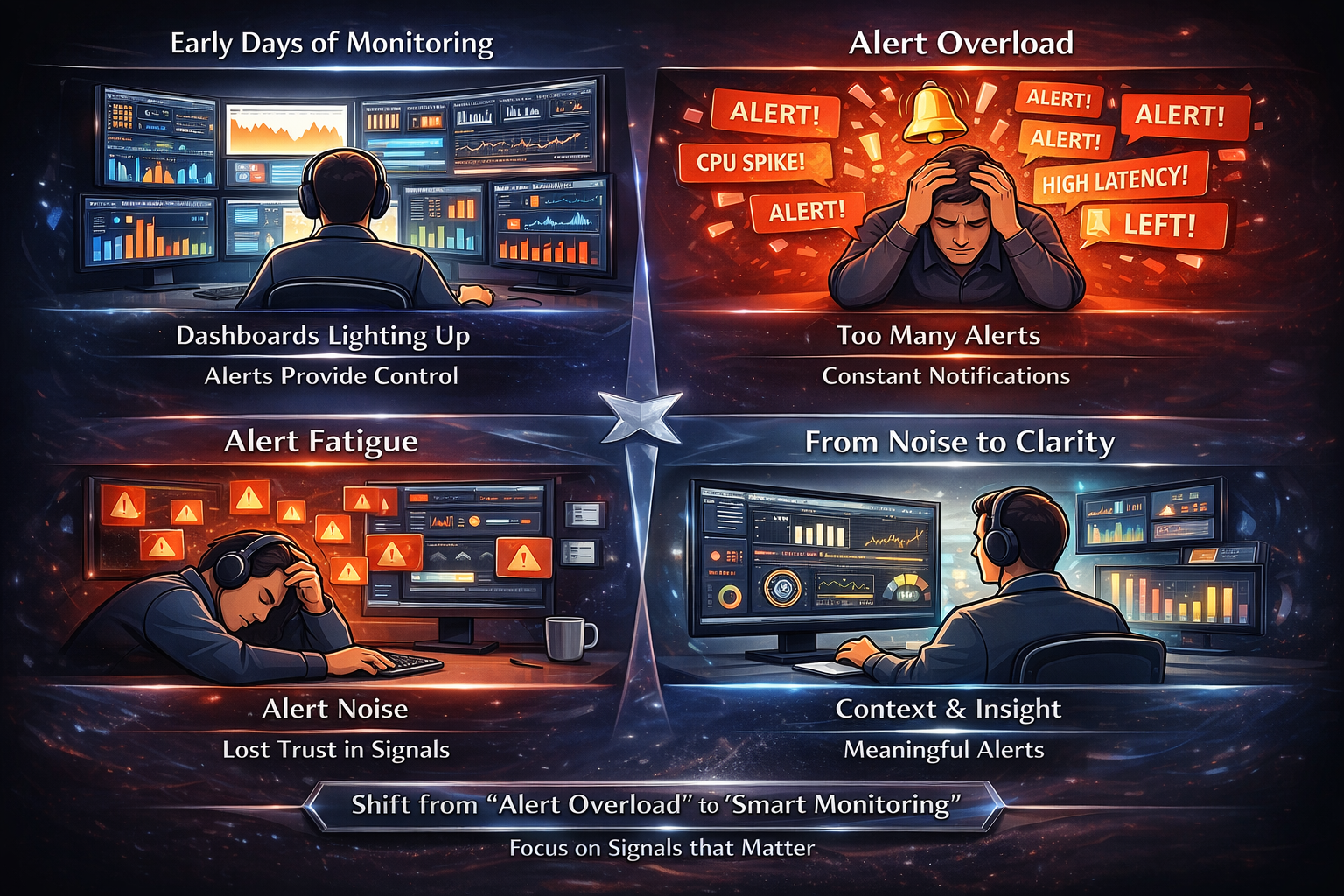
In the early days of adopting DevOps practices, adding monitoring feels like a breakthrough. For the first time, systems are no longer black boxes. Metrics start flowing in, dashboards light up with activity, and alerts act as an early warning system for anything that goes wrong. It creates a sense of control—like every part of the system is now visible and manageable.
But as systems grow, something subtle begins to change.
What started as a handful of meaningful alerts slowly turns into a constant stream of notifications. Every service emits signals, every metric has a threshold, and every threshold eventually becomes an alert. At first, teams respond to everything. Each notification is investigated, each anomaly is taken seriously. Over time, however, patterns begin to emerge. Certain alerts resolve on their own. Some repeat frequently without leading to real issues. Others seem important but lack enough context to justify immediate action.
Without realizing it, teams begin to adapt—not by improving the system, but by adjusting their behavior.
They start filtering alerts mentally. Then they start ignoring some of them. Eventually, they trust fewer and fewer of the signals they receive. This is the point where monitoring stops being helpful and starts becoming noise.
Alert fatigue is not caused by having alerts. It is caused by having too many alerts without enough meaning behind them.
Modern infrastructure makes this problem almost inevitable. Systems today are highly dynamic. They scale based on demand, distribute workloads across multiple services, and operate across different environments. Each of these layers introduces variability. CPU usage fluctuates, memory consumption shifts, traffic patterns spike and drop. When alerting systems are built on static thresholds applied to such dynamic environments, they generate signals that don’t always reflect real problems.
A temporary spike in CPU usage may trigger an alert, even if the system is functioning exactly as expected. A short-lived increase in latency might appear critical, even though it resolves within seconds. When these kinds of alerts accumulate, they dilute the importance of truly critical ones.
The deeper issue is not volume alone—it is the absence of context.
An alert, by itself, is just a signal that something crossed a predefined condition. It does not explain why it happened, whether it matters, or what should be done about it. Without context, every alert demands attention but provides little guidance. Engineers are left to investigate manually, correlating data across dashboards and logs, trying to determine whether the alert represents a real issue or just noise.
Over time, this constant interruption has a measurable impact. It increases cognitive load, making it harder for engineers to focus on meaningful work. It slows down response times because attention is divided across too many signals. Most importantly, it erodes trust in the monitoring system itself. When alerts are frequently perceived as unnecessary, they lose credibility. And once trust is lost, even critical alerts risk being overlooked.
This creates a paradox. Monitoring systems are implemented to improve reliability, but when poorly structured, they can actually reduce it.
To understand how to address this, it’s important to rethink what alerts are supposed to represent. Not every deviation in a system is a problem. Systems are designed to handle variability. What matters is not whether a metric changes, but whether that change has meaningful impact.
This is where the distinction between noise and signal becomes critical.
Noise consists of events that are technically valid but operationally insignificant. Signal represents events that require attention because they affect system behavior in a meaningful way. The challenge is that traditional alerting systems are not designed to make this distinction effectively. They operate on predefined rules, not on understanding.
As a result, they treat all threshold breaches as equally important, even when they are not.
What teams actually need is not more alerts, but better interpretation of the signals they already have. Instead of reacting to isolated events, they need to observe patterns. Instead of focusing on single metrics, they need to understand how different signals relate to each other over time.
For example, a spike in resource usage might not mean much on its own. But when viewed alongside deployment activity, traffic changes, and historical patterns, it starts to form a clearer picture. This shift—from isolated alerts to contextual understanding—is what transforms monitoring into something truly useful.
It also changes how teams interact with their systems. Instead of being interrupted constantly, they become aware continuously. Instead of reacting to every alert, they respond to meaningful changes. Instead of treating monitoring as a defensive mechanism, they use it as a source of insight.
This doesn’t eliminate alerts, but it restores their purpose.
An effective alert should not exist simply because a metric crossed a threshold. It should exist because something important is happening. It should carry enough context to guide action, not just demand attention. And it should be rare enough that when it appears, it is taken seriously.
Achieving this requires a shift in how visibility is approached. It’s no longer about collecting more data or configuring more rules. It’s about structuring information in a way that aligns with how systems actually behave. It’s about connecting signals, identifying patterns, and presenting them in a way that supports decision-making rather than interrupting it.
This is the direction modern DevOps is moving toward. As systems continue to grow in complexity, the ability to interpret signals becomes more valuable than the ability to generate them. Teams are beginning to recognize that visibility is not defined by how much information is available, but by how clearly that information can be understood.
Platforms like DevOpsArk reflect this shift, focusing less on increasing the volume of alerts and more on enabling teams to make sense of what their systems are already telling them.
Because in the end, the goal of monitoring is not to create noise. It is to create clarity.
And clarity is what allows teams to act with confidence.
Final Takeaway
When alerts lose meaning, systems lose visibility.
And when visibility is lost, reliability is only a matter of time.
Recent Posts
- The Hidden Cost of Too Many Dashboards: Why Infrastructure Visibility Gets Harder as Systems Grow
- Why Kubernetes Starts Feeling Unpredictable After a Certain Scale
- Server Deployment Automation: Why Reliable Deployments Become Difficult at Scale
- Modernizing Server Build Workflows for Scalable DevOps Operations
- CI/CD Pipeline Chaos: Why Modern DevOps Teams Need Better Workflow Automation