



Still Writing
Dockerfiles Manually? Here’s How ArkBuilder Simplifies Image Builds
Introduction Building container images is a fundamental part of
modern application development. But for many teams, it
Introduction
Building container images is a fundamental part of modern application development. But for many teams, it is still one of the most tedious and error-prone steps in the pipeline.
From writing Dockerfiles to managing dependencies, configuring environments, and debugging failed builds — the process often requires deep expertise and constant maintenance.
Even experienced developers can spend hours fixing small issues in build configurations.
So the question is — why is something so essential still so complicated?
The Hidden Complexity of Image Builds
At first glance, building a container image seems simple. You write a Dockerfile, run a build command, and push the image to a registry.
But in reality, things are rarely that straightforward.
Different applications require different base images, dependencies must be handled carefully, and environment configurations vary across projects. A small mistake in a Dockerfile can lead to failed builds or inefficient images.
In many cases, teams also need dedicated build infrastructure, which adds another layer of complexity. Managing build agents, allocating resources, and ensuring consistency across environments becomes a challenge.
Why Traditional Build Pipelines Fall Short
Most teams rely on CI/CD tools to handle builds. While these tools automate the process, they don’t necessarily simplify it.
Developers are still responsible for writing and maintaining Dockerfiles, configuring pipelines, and troubleshooting issues when builds fail.
This leads to:
Increased development time
Building container images often requires developers to spend significant time writing, testing, and debugging Dockerfiles. Even small misconfigurations can lead to failed builds, forcing teams to repeatedly troubleshoot issues instead of focusing on feature development.
Dependency on DevOps expertise
Modern build pipelines frequently rely on specialized DevOps knowledge. Developers must understand containerization, build tools, and infrastructure setup, which creates a dependency on experienced DevOps engineers for even routine tasks.
Inconsistent build environments
Without standardized configurations, builds can behave differently across environments. Variations in dependencies, base images, or system settings often lead to unpredictable results, making debugging more difficult and reducing reliability.
Difficulty scaling build processes
As applications grow and teams expand, build processes become harder to manage. Scaling requires additional infrastructure, resource allocation, and coordination, which increases operational overhead and slows down development workflows.
Instead of accelerating development, builds often become a bottleneck.
Introducing ArkBuilder
ArkBuilder, a core component of DevOpsArk, is designed to remove this complexity.
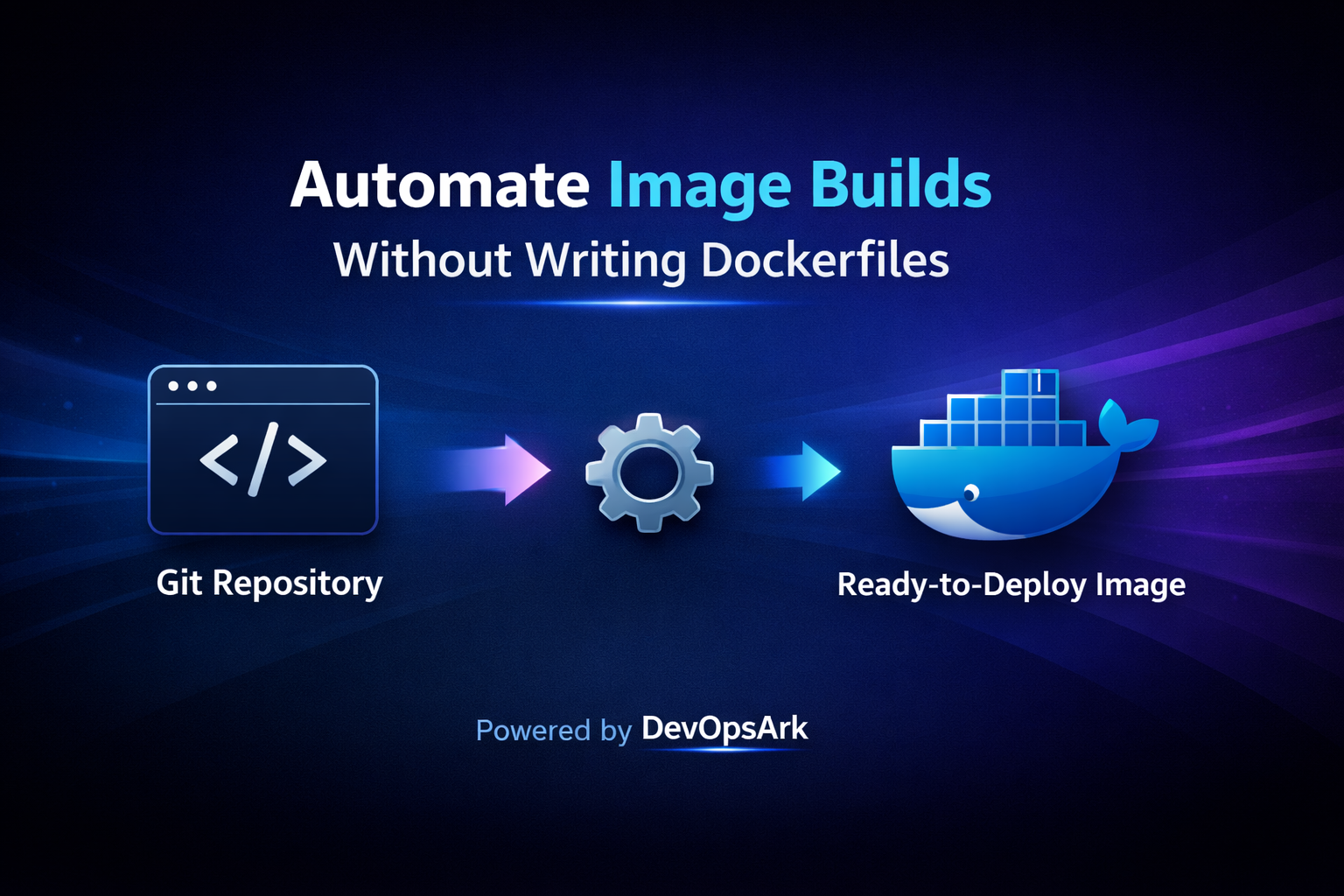
It allows teams to build container images directly from source code without requiring manual Dockerfile management.
By automating the build process and handling configurations behind the scenes, ArkBuilder makes image creation faster, simpler, and more reliable.
How ArkBuilder Works
With ArkBuilder, the process starts by connecting your Git repository.
Once connected, the platform analyzes your application and automatically generates the necessary build configuration. There’s no need to manually write or maintain Dockerfiles.
You can define resource limits for builds, monitor logs in real time, and track the status of each build — all from a single interface.
After the build is complete, the image is pushed to a container registry, ready for deployment.
Why This Changes Everything
ArkBuilder transforms the way teams handle builds.
Instead of worrying about configurations and infrastructure, developers can focus on writing code. Builds become predictable, consistent, and easier to manage.
This leads to:
Faster build times
ArkBuilder automates the entire image creation process, eliminating repetitive setup and manual configurations. This significantly reduces the time required to go from source code to a deployable container image, enabling quicker iterations and faster releases.
Reduced manual effort
By removing the need to write and maintain Dockerfiles, ArkBuilder minimizes hands-on work for developers. Teams no longer have to manage build scripts or troubleshoot configuration issues, allowing them to focus more on application development.
Fewer configuration errors
Since build configurations are automatically generated and standardized, the chances of human error are greatly reduced. This leads to more reliable builds and fewer failures caused by misconfigured environments or dependencies.
Scalable build processes
ArkBuilder is designed to handle growing workloads effortlessly. Whether building a single image or managing multiple projects, the platform scales seamlessly without requiring additional infrastructure management or complex setup.
Most importantly, it removes the dependency on deep container expertise for everyday tasks.
A Better Developer Experience
By simplifying image builds, ArkBuilder improves the overall developer experience.
New team members can get started quickly without needing to understand complex build systems. Existing teams can reduce the time spent debugging and maintaining pipelines.
It creates a smoother path from code to deployment.
Conclusion
Building container images shouldn’t be a barrier to development.
ArkBuilder removes unnecessary complexity and provides a streamlined way to go from source code to deployable images.
If your team is still spending too much time managing builds, it might be time to rethink the process.
Recent Posts
- The Hidden Cost of Too Many Dashboards: Why Infrastructure Visibility Gets Harder as Systems Grow
- Why Kubernetes Starts Feeling Unpredictable After a Certain Scale
- Server Deployment Automation: Why Reliable Deployments Become Difficult at Scale
- Modernizing Server Build Workflows for Scalable DevOps Operations
- CI/CD Pipeline Chaos: Why Modern DevOps Teams Need Better Workflow Automation