



Managing Kubernetes
Infrastructure Made Simple | DevOpsArk
Introduction Kubernetes has become the backbone of modern cloud-native
applications. It enables organizations to deploy, scale, and
Introduction
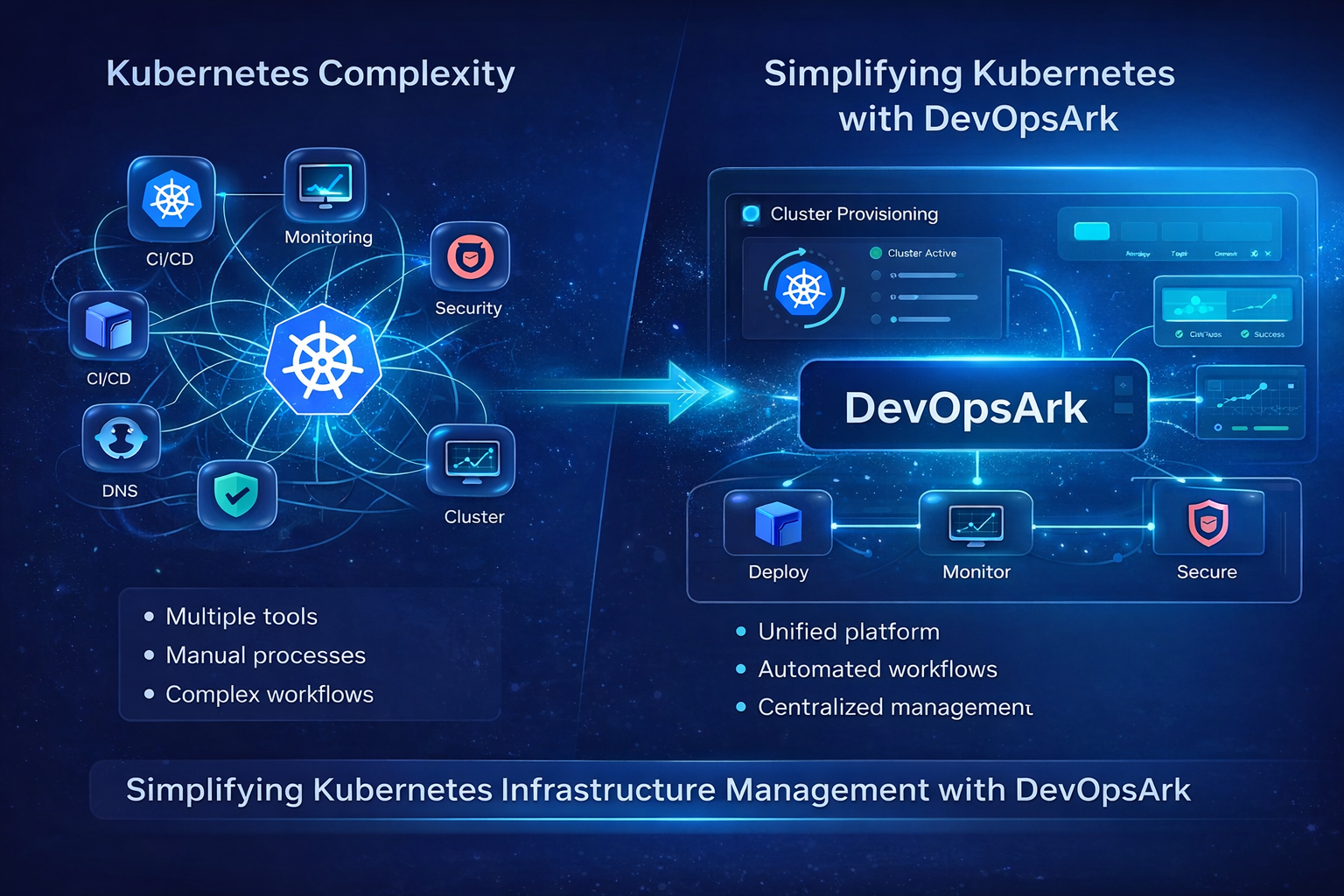
Kubernetes has become the backbone of modern cloud-native applications. It enables organizations to deploy, scale, and manage containerized workloads efficiently across distributed environments.
However, as adoption grows, managing Kubernetes infrastructure becomes increasingly complex.
From provisioning clusters to handling deployments, networking, monitoring, and security, teams often struggle to maintain consistency and control across environments.
This complexity slows down development, increases operational overhead, and introduces potential risks.
So how can teams simplify Kubernetes management without sacrificing flexibility and scalability?
What is Kubernetes?
Kubernetes is an open-source container orchestration platform designed to automate the deployment, scaling, and management of containerized applications.
It provides organizations with a standardized way to manage applications across environments, ensuring consistency, scalability, and reliability.
With Kubernetes, teams can efficiently handle application deployments, manage workloads dynamically, and ensure high availability even in distributed systems.
Challenges in Kubernetes Management
While Kubernetes offers powerful capabilities for managing modern applications, operating it in real-world environments introduces a range of complexities. As infrastructure scales and environments become more distributed, these challenges can significantly impact productivity and operational efficiency.
Organizations often struggle to maintain consistency, visibility, and control while managing Kubernetes clusters across different environments.
Cluster Complexity
Setting up and maintaining Kubernetes clusters requires deep expertise in networking, storage, and system configuration. Managing control planes, worker nodes, upgrades, and configurations can become resource-intensive, especially as the number of clusters grows.
Without proper standardization, even small configuration differences can lead to unexpected issues in production environments.
Multi-Cloud and Hybrid Environments
Modern organizations rarely operate in a single environment. Kubernetes deployments often span across multiple cloud providers and on-premise infrastructure, making management significantly more complex.
Ensuring consistency across these environments, while handling differences in cloud services and configurations, becomes a major operational challenge.
Networking and DNS Management
Networking in Kubernetes involves multiple layers, including services, ingress controllers, and load balancers. Configuring and managing these components correctly is critical for application availability.
In addition, handling DNS configurations across environments adds another layer of complexity, where misconfigurations can directly impact application accessibility.
Security and Access Control
Securing Kubernetes environments requires careful management of role-based access control (RBAC), secrets, and security policies. As teams grow, maintaining proper access control becomes increasingly difficult.
Any misconfiguration in permissions or exposure of sensitive data can lead to serious security risks.
Monitoring and Troubleshooting
Identifying performance issues and failures in Kubernetes environments requires comprehensive visibility into system metrics and logs. Without proper monitoring tools, troubleshooting becomes time-consuming and inefficient.
Lack of observability can delay issue resolution and impact application performance and reliability.
To overcome these challenges, organizations are increasingly adopting unified DevOps platforms that simplify Kubernetes management and improve operational efficiency.
Traditional Approach to Kubernetes Management
In many organizations, Kubernetes management involves using multiple tools and manual processes. Teams rely on command-line tools, separate monitoring solutions, CI/CD platforms, and custom scripts to manage different aspects of the infrastructure.
This fragmented approach introduces complexity, increases the learning curve, and makes it difficult to maintain consistency across environments.
As a result, teams spend more time managing tools and integrations rather than focusing on building and delivering applications.
Simplifying Kubernetes with DevOps Platforms
To address these challenges, modern DevOps platforms aim to unify infrastructure management, deployment, monitoring, and security into a single system.
By consolidating these capabilities, organizations can reduce tool sprawl, improve visibility, and automate repetitive tasks.
This approach enables teams to standardize workflows, improve collaboration, and operate more efficiently at scale.
How DevOpsArk Simplifies Kubernetes Management
DevOpsArk provides a unified platform designed to simplify Kubernetes infrastructure management while maintaining flexibility, scalability, and control.
Instead of relying on multiple disconnected tools, DevOpsArk brings all essential DevOps capabilities into a single platform, enabling teams to streamline operations and reduce complexity.
Centralized Cluster Management
Managing Kubernetes clusters across different environments can quickly become overwhelming. DevOpsArk simplifies this by providing a centralized interface where teams can provision, monitor, and manage clusters from a single location.
This eliminates the need to switch between multiple tools and significantly reduces operational overhead.
Automated Infrastructure Provisioning
Provisioning infrastructure manually often leads to inconsistencies and delays. DevOpsArk automates the process of creating and managing Kubernetes clusters, ensuring consistent configurations across environments.
This not only saves time but also reduces the chances of configuration errors.
Seamless Application Deployment
Deploying applications to Kubernetes environments typically involves multiple tools and steps. DevOpsArk simplifies this by integrating deployment workflows into a single platform.
This makes the deployment process faster, more reliable, and easier to manage.
Integrated Monitoring and Observability
Visibility into system performance is critical for maintaining application health. DevOpsArk provides built-in monitoring and observability features that allow teams to track resource usage and detect issues in real time.
This eliminates the need for external monitoring tools and improves troubleshooting efficiency.
Security and Access Control
Security is a critical aspect of Kubernetes management. DevOpsArk simplifies security by providing integrated tools for managing access control, secrets, and policies.
This helps organizations maintain secure environments while ensuring compliance and governance.
Kubernetes Workflow with DevOpsArk
With DevOpsArk, managing Kubernetes becomes a streamlined and efficient process. Teams can provision infrastructure, deploy applications, monitor performance, scale workloads, and secure their environments — all from a single platform.
Provision cluster → Deploy application → Monitor → Scale → Secure
This unified workflow reduces manual effort, improves efficiency, and enables teams to focus on delivering value rather than managing complexity.
Conclusion
Kubernetes is a powerful platform for managing modern applications, but its complexity can create significant challenges for engineering teams.
Managing infrastructure, deployments, security, and monitoring across environments requires a more streamlined and unified approach.
DevOpsArk simplifies Kubernetes infrastructure management by bringing all essential DevOps capabilities into a single platform.
By reducing complexity, improving visibility, and enabling automation, DevOpsArk helps organizations build, deploy, and operate applications more efficiently.
Simplify DevOps. Amplify productivity.
- Container Orchestration
- Deployment Strategies (K8s)
- DevSecOps
- Kubernetes
- Kubernetes Clusters
- Kubernetes Management
- Pod Management
Recent Posts
- The Hidden Cost of Too Many Dashboards: Why Infrastructure Visibility Gets Harder as Systems Grow
- Why Kubernetes Starts Feeling Unpredictable After a Certain Scale
- Server Deployment Automation: Why Reliable Deployments Become Difficult at Scale
- Modernizing Server Build Workflows for Scalable DevOps Operations
- CI/CD Pipeline Chaos: Why Modern DevOps Teams Need Better Workflow Automation